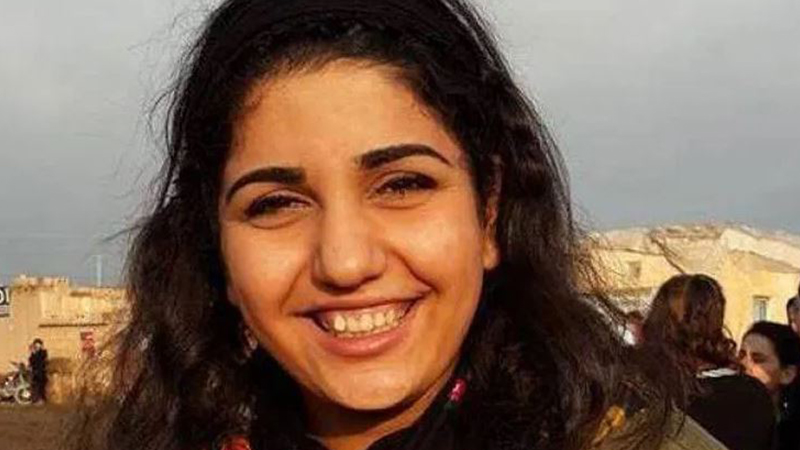
On 3 December 2015, Dilan Kortak was killed during a police operation at the house where she was staying in the Sancaktepe district of Istanbul. According to the crime scene report, police had received intelligence that Kortak might be the person believed to be preparing an attack against the police. Officers went to the address and entered the house. The report states that they warned her to surrender, shouting “Police! Surrender!” Shots were then fired at the officers, who returned fire.
The crime scene examination found signs that the door had been forced open. Kortak was found lying face down and dead, with a firearm and a magazine next to her. Two other firearms and numerous empty cartridge cases were recovered from the house.
According to the autopsy report, Kortak sustained 25 gunshot wounds, 21 of which were individually fatal. The shot to the head was fired from near-contact range. The report also noted that Kortak’s clothing would need to be examined to determine the firing distance of the other shots.
A chemical examination identified 17 distant-range gunshot entry holes on the back of Kortak’s cardigan and seven on the back of her trouser legs. Gunshot residue was also detected on her hands. However, the report specifically noted that this did not establish that she had fired a weapon, as the residue could also have resulted from contact or proximity.
According to the Istanbul Police Forensic Laboratory report, Kortak’s fingerprints were not found on any of the three handguns recovered from the scene. An examination of 68 cartridge cases and 32 deformed bullets also found that most had not been fired from those firearms. Differences in calibre and type indicated that they had been fired from another 9 mm Parabellum-type firearm, which could not be identified.
On 6 April 2016, the Chief Public Prosecutor’s Office issued a decision of non-prosecution in respect of the police officers who had participated in the operation. The decision found that the officers had acted in self-defence, that the conditions for the use of firearms had been met, and that their conduct had not been unlawful. The family’s lawyers objected to the decision on 4 May 2016. The objection was rejected by the Criminal Peace Judgeship on 24 May 2016. An individual application was subsequently lodged with the Constitutional Court on 15 August 2016.
On 10 December 2019, the Constitutional Court found that the investigation had not met the requirements of Article 17 of the Constitution. It held that the procedural aspect of the right to life had been violated and ordered a new investigation.
The Constitutional Court identified several shortcomings that prevented an assessment of whether the use of force had been absolutely necessary and proportionate. These included the relationship between the near-contact-range shot to the head and the 25 gunshot wounds, 21 of which were individually fatal. The Court also pointed to the inconsistency between the absence of Kortak’s fingerprints on the firearms and the allegation that she had fired a weapon. Most importantly, it noted that an on-site inspection involving a reconstruction of the incident, which could have helped clarify the circumstances, had never been conducted.
Following the Constitutional Court’s decision, a new investigation was opened under Investigation No. 2020/71106. On 17 March 2023, the Civil Servants Offences Investigation Bureau of the Istanbul Anatolian Chief Public Prosecutor’s Office issued an indictment against Fatih İnan Bayazit, Yusuf Yavuz Alemdar and Osman Yıldız for killing with conscious negligence.
On the same day, a supplementary decision of non-prosecution was issued in respect of the other nine police officers who had participated in the operation: Samed Gönültaş, Mustafa Sert, Muhammed Eser, Mehmet Yaman, Efkan Özergül, Faruk Selim Kayıncıoğlu, Gökhan Babur, İlker Ağpınar and İsmail Işık. The family’s lawyers objected to this decision on 4 April 2023, arguing that the shortcomings identified by the Constitutional Court had not been remedied.
The first hearing was held on 15 June 2023 before the Istanbul Anatolian 68th Criminal Court of First Instance. Counsel for the complainant argued that the testimony of police officer E.Ö., who was heard as a witness, contradicted the statements he had given during the investigation and contained details that did not appear in the incident report. They also argued that the preparation of the report might amount to the offence of intellectual forgery.
Counsel stated that 25 of the 68 shots fired had struck Kortak and that 21 of those wounds were individually fatal. They also noted that one shot had been fired into the back of her head from near-contact range. On this basis, they argued that the conduct constituted intentional homicide and requested that the case be referred to the Assize Court. They also requested that Kortak’s clothing be sent to the Council of Forensic Medicine (ATK) for a report on firing distance, that an on-site inspection involving a reconstruction of the incident be conducted, and that the relevant inventory records be obtained.
Defence counsel argued that the incident fell within the scope of self-defence. The court decided that the outstanding evidentiary matters be completed and that it would consider the request for a decision of lack of jurisdiction at the next hearing.
At the second hearing on 3 October 2023, counsel for the complainant reiterated that the conduct constituted intentional homicide and again requested a decision of lack of jurisdiction. The public prosecutor submitted an opinion that the conduct might constitute killing with eventual intent (dolus eventualis). In line with the prosecutor’s opinion, the court issued a decision of lack of jurisdiction. The case file was transferred to the Istanbul Anatolian 16th Assize Court on 8 January 2024, and the first hearing was scheduled for 26 April 2024.
At the first hearing on 26 April 2024, the court accepted the family’s applications to join the proceedings. It issued an arrest warrant for Osman Yıldız and ordered that Kortak’s belongings be sent to the Council of Forensic Medicine (ATK) for a report on firing distance. The court also requested records from the Istanbul Police Department concerning the firearms and ammunition issued to the defendants, as well as a report stating that no long-barrelled firearms had been used.
The court rejected the requests to remand the defendants in custody pending trial, to file a criminal complaint against witness E.Ö. for perjury, and to conduct an on-site inspection. It also rejected the requests relating to FETÖ and to obtain the case file concerning allegations that Kortak’s father had engaged in propaganda for an organisation. The hearing was adjourned to 22 November 2024.
At the second hearing on 22 November 2024, the court maintained the arrest warrant for Osman Yıldız and imposed travel bans on the other two defendants. It also ordered an investigation into the use of a helicopter and again ordered that Kortak’s belongings be sent to the Council of Forensic Medicine (ATK). The on-site inspection was again postponed, and the requests to remand the defendants in custody were rejected.
At the third hearing on 18 April 2025, the court maintained the arrest warrant and travel bans and again rejected the requests to remand the defendants in custody. It ordered that the witnesses referred to in the Constitutional Court’s decision, who had not yet been heard, give evidence. The court also ordered that the related Assize Court case files be brought before it.
The court rejected requests to identify the intelligence officer, investigate whether the defendants had participated in other operations, hear the residents of the apartment building as witnesses, and file a criminal complaint. It made no decision on the request for an on-site inspection. At this stage, it had still not been established where Kortak’s clothing was or to whom it had been delivered.
At the fourth hearing on 7 November 2025, the composition of the trial bench had changed. The court learned that the person who had lived at the address where the incident occurred had died. The related case files had also been joined and delivered to the court in four sacks.
The court maintained the arrest warrant and travel bans. It again rejected requests for a Red Notice, further investigation into the helicopter flight information, disclosure of the intelligence officer’s identity, and the hearing of the apartment residents as witnesses. The court also declined to conduct an on-site inspection at that stage.
At the fifth hearing, held on 6 March 2025, the composition of the trial bench had changed once again. Counsel for the intervening parties reiterated that the incident involved a near-contact-range shot to the back of the head. They also argued that the allegation concerning a firearm not recorded in the inventory had not been sufficiently investigated and again requested the GPS and camera records of the armoured vehicles.
The court issued a Red Notice for Osman Yıldız. However, it rejected requests to file a criminal complaint against the Governor and the Provincial Police Chief, identify the intelligence officer, and obtain footage from the armoured vehicles. The court ordered an on-site inspection for 15 May 2026, approximately six and a half years after the Constitutional Court’s 2019 decision.
The on-site inspection was conducted on 15 May 2026. The trial bench, the prosecutor, counsel for the parties, two defendants and expert witnesses were present. The incident was reconstructed from the entrance of the apartment building, and video and audio recordings were made.
Before the inspection began, masked and armed police officers from an “Operation Team” arrived at the scene, although the court had not requested their presence. The presiding judge said that such a measure was unnecessary. The inspection lasted approximately five hours. Afterwards, counsel for the intervening parties requested a luminol examination and bloodstain pattern analysis at the scene. The court instructed the panel of experts to submit a preliminary report within ten days on whether these examinations were necessary.
At the hearing on 10 July 2026, the experts had still not submitted their preliminary report within the prescribed period. The court issued another summons, warning that a criminal complaint for neglect of duty would be filed if the report was not submitted. No decision had yet been made on the request for a luminol examination and bloodstain pattern analysis.
The next hearing will be held on 6 November 2026 at 10.00.