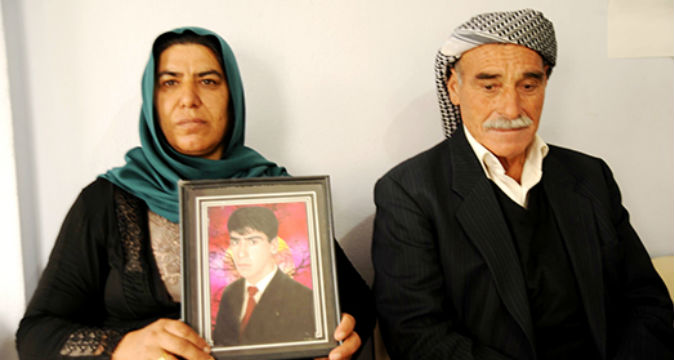
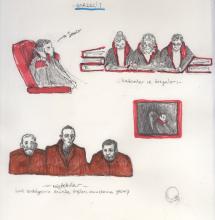
On 30 October 2014, the first indictment was issued in the investigation into the enforced disappearance of eight individuals in the district of Dargeçit, Mardin, between 29 October 1995 and 8 March 1996, including one specialist sergeant and three children. The individuals whose enforced disappearances remain unresolved within the scope of the Dargeçit Case are Abdurrahman Olcay, Abdurrahman Coşkun, Davut Altınkaynak, Mehmet Emin Aslan, Nedim Akyön, Seyhan Doğan, Süleyman Seyhan, and Bilal Batırır. The indictment sought the prosecution of Hurşit İmren, then Commander of the Mardin Gendarmerie Commando Battalion; Mehmet Tire, then Commander of the Dargeçit District Gendarmerie; Mahmut Yılmaz, Commander of the Dargeçit Central Gendarmerie Station; Haydar Topçam, Deputy Commander of the Gendarmerie Station; and Specialist Sergeant Kerim Şahin on charges of intentional killing. However, a decision of non-prosecution was issued in respect of 16 suspects—most of whom were village guards—whose names had appeared in the investigation file, and the enforced disappearance of Hikmet Kaya was not included in the case file. The Midyat Criminal Court of Peace, partially granting the objection lodged by the Mardin Branch of the Human Rights Association (İHD), dismissed the application concerning the disappearance of Hikmet Kaya for lack of sufficient evidence, while accepting the request for the preparation of a supplementary indictment against those suspects in respect of whom a decision of non-prosecution had been issued. A second supplementary indictment subsequently added Faruk Çatak, Mahmut Ayaz, Naif Çelik, Ramazan Savcı, Kemal Kaya, Mehmet Acar, Faik Acar, Hüseyin Altunışık, Mehmet Emin Çelik, Sadık Çelik, Fethullah Çelik, Osman Demir, and Bahattin Ergel as defendants in the case. Before the trial commenced, the proceedings were transferred to the Adıyaman High Criminal Court on security grounds.
Following the first hearing before the Adıyaman 1st Assize Court on 1 October 2015, the court requested authorisation from the High Council of Judges and Prosecutors (HSYK) for the prosecution of one of the defendants, Mehmet Tire.
The victims' families and their counsel for the intervening parties in Dargeçit were unable to attend the second hearing, held on 29 December 2015, due to the ongoing curfew in Dargeçit. At that hearing, the victims' lawyers submitted a motion for the recusal of the trial bench, arguing that the court had improperly sought authorisation from the HSYK.
At the third hearing, held on 3 May 2016, a Forensic Medicine Institute report was introduced before the court, confirming that the human remains recovered during the investigation belonged to Davut Altınkaynak and Nedim Akyön. Defendants Kerim Şahin and Fethullah Çelik gave their statements via SEGBİS (the Audio and Video Information System). Once again, the requests made by the complainants' lawyers for the defendants -who had not been brought to the hearings on security grounds- to be produced before the court and heard in person were dismissed.
At the hearing held on 3 October 2016, relatives of the disappeared were heard as witnesses. Testimony was given by Abdulgafur Coşkun, the brother of Abdurrahman Coşkun; Kania Altınkaynak, the sister-in-law of Davut Altınkaynak; Zeliha Akyön, the sister-in-law of Nedim Akyön; and Mümine Seyhan, the wife of Süleyman Seyhan.
The lawyers representing the families of the disappeared argued that, despite the court's decision of 14 July 2016 requiring defendant Mehmet Tire to give his statement via SEGBİS, the court had failed to take the necessary steps to enforce that order. They therefore requested that Mehmet Tire, together with all other defendants, be remanded in custody pending trial. In the alternative, they sought the imposition of judicial control measures and travel bans on all defendants. In its interim ruling, the court dismissed the request for detention, ordered the imposition of judicial control measures and travel bans on all defendants, and further ordered that Mehmet Tire be compelled to appear in order to give his statement via SEGBİS.
At the hearing held on 5 December 2016, Mehmet Tire, giving his statement via SEGBİS (the Audio and Video Information System), claimed that he had not been in Dargeçit at the time of the events, that he had sustained an eye injury, and that following surgery he had been on medical leave for two months. At the same hearing, Hayat Altınkaynak, the mother of Davut Altınkaynak (13), one of the disappeared, gave her statement as a complainant, while Emin Coşkun testified as a witness. The court rejected defendant Mehmet Tire's request to be excused from attending future hearings, while ordering that the travel bans imposed on all defendants remain in force.
At the hearing held on 13 March 2017, the court heard the statements of the intervening parties and witnesses. The prosecutor requested that the proceedings be joined with the Kızıltepe JİTEM Case pending before the Ankara 5th High Criminal Court. Counsel for the intervening parties, Att. Erdal Kuzu, argued that, as the proceedings had already reached the final stage before judgment, there was no legal benefit in joining the two cases. In its interim ruling, the court ordered the joinder of the proceedings and ruled that the trial should continue under Case File No. 2014/367 before the Ankara 5th High Criminal Court. To resolve the jurisdictional dispute between the courts, the case file was first referred to the 5th Criminal Chamber of the Court of Cassation.
On 19 October 2017, the Court of Cassation found that the joinder was not justified and ruled definitively that the Adıyaman 1st High Criminal Court had jurisdiction over the case. The case file was subsequently returned to the Adıyaman 1st High Criminal Court.
The proceedings resumed at a hearing before the Adıyaman 1st High Criminal Court on 27 April 2018. It was noted that the composition of the trial bench that had ordered the joinder had changed. During the hearing, counsel for the intervening parties, Av. Erdal Kuzu, stated that “there was both a legal and factual connection between the present case and the Kızıltepe JİTEM Case pending in Ankara, and that the failure to join the proceedings had prevented the activities of JİTEM from being fully exposed”. He therefore expressed his disagreement with the ruling of the Court of Cassation. Kuzu further requested that a supplementary indictment be issued in respect of offences allegedly committed by the defendants within the JİTEM organisation. Alternatively, he requested that the defendants be invited to submit additional statements regarding charges of leading or membership of an organisation. Referring to a document added to the case file the previous year concerning Mehmet Tire's injury in 1996—which stated that Tire had been injured while travelling to a military shelter—Kuzu also requested that the court enforce its previous interim ruling ordering the Mardin Provincial Gendarmerie Command to determine the coordinates of both the cave where the remains of the disappeared had been found and the military shelter. During the hearing, the court issued an arrest warrant for defendant Bahattin Ergel in order to secure his appearance before the court for questioning and the taking of his defence.
At the hearing held on 11 July 2018, Av. Ramazan Güler, counsel for defendant Faruk Çatak, and defendant Mahmut Yılmaz, who attended the hearing via SEGBİS from Ankara, requested that the anonymous witnesses, whose statements had been admitted as evidence, be heard in person before the court. Counsel for defendant Haydar Topçam, Av. Nazmi Gökçe, who also participated via SEGBİS, argued that the sole objective of the victims' lawyer was to obtain compensation and requested that the application to hear the anonymous witnesses be dismissed. The court further noted that the Mardin Provincial Gendarmerie Command had submitted its response concerning the coordinates requested by the court. However, the hearing record contained no information as to when the response had been added to the case file or what information it contained.
At the hearing held on 22 October 2018, it emerged from the response submitted by the Mardin Provincial Gendarmerie Command that the coordinates of the military shelter referred to in the 1995 report concerning Mehmet Tire's injury were identical to those of the cave where the remains of Nedim Akyön and Davut Altınkaynak had been discovered. During the hearing, defendant Haydar Topçam stated that “he had served as the deputy commander of the gendarmerie station at the relevant time, that judicial procedures had been handled by the station commander rather than himself, and that he had prepared the report concerning Mehmet Tire's injury”. Defendant Faruk Çatak, for his part, “stated that he had not possessed the authority to order detentions and that such authority had rested with the station commander”. The court granted the request of counsel for the intervening parties, Av. Erdal Kuzu, for Mahmut Yılmaz, Mehmet Tire, and Hurşit İmren to be heard again in light of the newly emerged evidence. It also ordered that the anonymous witnesses be heard via SEGBİS between hearings
At the hearing held on 6 February 2019, witnesses, including the then District Governor of Dargeçit, testified that JİTEM had carried out detentions that had not been officially recorded and that some of those detained had subsequently been executed. The court ordered the appointment of a panel of experts to conduct an on-site inspection in order to determine the distance between the location where defendant Mehmet Tire had been injured and the site where the victims' remains had been discovered, and to prepare a site inspection report.
At the hearing held on 13 May 2019, the court heard the statement of Hazni Doğan, a complainant who stated that he had been a first-hand witness to the events giving rise to the case. Doğan, who also stated that he had been subjected to torture, testified that his brother Seyhan Doğan had been suspended in the Palestinian hanging position, that Abdurrahman Olcay had also been there, and that he had heard the voice of Mehmet Emin Aslan. Other intervening parties, Abdülkerim Kaya and Osman Seyhan, also declared that they were complainants in the proceedings. Counsel for the intervening parties, Av. Erdal Kuzu, noted that the court had ordered the examination of the then District Governor of Dargeçit, Adem Kul, one and a half years earlier, and requested that the court ensure his appearance by appropriate means. He further stated that although he had reviewed the site inspection report, neither he nor his clients had been notified of the inspection and had therefore been unable to attend. Arguing that the defendants' continued release pending trial undermined the interests of justice, Av. Kuzu requested that they be remanded in custody. The trial bench ruled that Hazni Doğan should be admitted to the proceedings as an intervening party, on the grounds that he may have suffered harm as a result of the offence. It dismissed Av. Erdal Kuzu's request that the defendants be detained pending trial and ordered that the address of witness Adem Kul be established and that he be produced before the court at the next hearing.
At the hearing held on 30 September 2019, the prosecutor requested that the court obtain information regarding the status of the Kızıltepe JİTEM Case pending before the Ankara 5th High Criminal Court and that the request for the registration of Abdurrahman Olcay's death in the civil registry be considered after the relevant Council of Forensic Medicine (ATK) reports had been examined. The trial bench once again rejected the request for the defendants to be remanded in custody. It further ordered that renewed letters of request be sent to the competent courts for the examination of witnesses Adem Kul and Ahmet Çiçek, that orders compelling their appearance be issued, and that officials who failed to execute those orders would be reported to the public prosecutor. The court also ruled that the request concerning the registration of Abdurrahman Olcay's death in the civil registry would be considered after the relevant Council of Forensic Medicine (ATK) reports had been examined, and ordered that the case file of the Kızıltepe JİTEM Case be requested from the Ankara 5th High Criminal Court.
At the hearing held on 23 December 2019, all defence lawyers submitted petitions requesting to be excused from attending the hearing, and none of them appeared before the court. The witnesses for whom orders compelling appearance had been issued at the previous hearing also failed to appear before the court. It was reported that their addresses could not be located. The trial bench ordered that a letter of request be sent to the Samsun 2nd High Criminal Court for the testimony of Adem Kul, who had been convicted of membership in the FETÖ/PDY terrorist organisation, to be taken via SEGBİS. The court also ordered that the necessary steps be taken to secure the testimony of the remaining witnesses, rejected the request to hear Hatice Batırır for a second time, and once again dismissed the requests for the defendants to be remanded in custody.
At the hearing held on 29 June 2020, counsel for the intervening parties, Av. Erdal Kuzu, stated that the case file had been transferred from the Midyat High Criminal Court in 2015 and that the investigation had been initiated fifteen years earlier. He argued that the proceedings, which had been prolonged over many years, should now be brought to a conclusion. Av. Kuzu requested that the case file be referred to the prosecution for the preparation of the prosecutor's opinion on the merits and that the court proceed to judgment. The trial bench ruled that, if the prosecution had any request for further evidentiary proceedings, it should submit it; otherwise, the case file would be referred to the prosecution for the preparation of the prosecutor's opinion on the merits.
At the hearing held on 2 November 2020, the testimony of Hazni Doğan was particularly significant. He testified that he had been detained together with his brother Seyhan Doğan, his brother-in-law Abdullah Olcay, and his uncle Abdurrahman Coşkun; that they had been subjected to torture for four days; that he himself had eventually been released; but that the others had subsequently been forcibly disappeared. The court once again rejected the intervening parties' request that the defendants be remanded in custody and ordered that the necessary steps be taken to verify the addresses of the witnesses who had not yet been heard.
The 14th hearing, held on 29 March 2021, commenced with the prosecutor reading the opinion on the merits. The prosecutor requested the acquittal of all defendants on the grounds that, “although the case file contained statements from the complainants and certain witnesses concerning the killings, some of those statements were based solely on hearsay; none of the witnesses had directly witnessed the defendants killing the victims; no video recordings of the incidents were available; and it was not possible to conduct a molecular genetic examination capable of producing highly reliable results by comparing the biological evidence recovered from the victims with samples obtained from the defendants”. As the defendants and their lawyers were not present at the hearing, the court granted them, as well as the intervening parties upon request, additional time to submit their observations on the merits.
At what had been expected to be the final hearing, held on 28 June 2021, it became clear that no judgment could be delivered due to a change in the composition of the trial bench. The former Deputy Director of the Provincial Directorate of National Education testified as a witness and stated that defendant Mehmet Tire had been in Dargeçit at the time of the events. In his submissions, Av. Erdal Kuzu stated that this was the fifth change in the composition of the trial bench, that it had delayed the case—already at the judgment stage—by at least another two years, that the statute of limitations would expire in 2025, and that he believed the repeated changes to the composition of the bench had been deliberate
At the hearing held on 11 October 2021, it was noted that an arrest warrant had been issued for Adem Kul, the prosecutor serving at the time of the events, who had not yet testified and who had subsequently been prosecuted for membership in the FETÖ/PDY terrorist organisation and released on probation. The court ordered that the necessary steps be taken to secure Adem Kul's testimony.
At the hearing held on 10 January 2022, members of the victims' families stated that, despite having travelled to Adıyaman more than twenty times in connection with the proceedings, no meaningful progress had been made and that they expected the case finally to reach a conclusion. The court ruled that a reasonable period should be allowed for the compulsory appearance of former prosecutor Adem Kul, who was being sought in order to testify as a witness.
At the final hearing held on 4 April 2022, the court ordered that information be requested regarding the status of the criminal proceedings against Adem Kul, who had been expected to testify as a witness.
At the judgment hearing held on 4 July 2022, the court acquitted “all defendants on the ground that no concrete, conclusive, and credible evidence capable of establishing beyond doubt that the defendants had committed the offences charged in a manner corresponding to their legal definition had been obtained”.
On 6 August 2022, the court issued its reasoned judgment. The acquittals were based on the findings that the witness statements were based solely on “hearsay”; “that none of the witnesses had directly observed the defendants killing the victims”; “that it had not been possible to conduct a molecular genetic examination capable of producing highly reliable results by comparing the biological evidence recovered from the victims with samples obtained from the defendants”; “that the official responses submitted to the court by public authorities did not corroborate the witness statements”; “that no concrete evidence existed establishing by whom or through what acts Abdurrahman Olcay and Abdurrahman Coşkun had been killed after their release”; “that no official records of detention existed in respect of Süleyman Seyhan, Mehmet Emin Aslan, Nedim Akyön, Seyhan Doğan, Hayat Altınkaynak, or Davut Altınkaynak; that even assuming they had in fact been detained without any official record, the case file contained no concrete evidence identifying the perpetrators or the manner in which the killings had been carried out”; and, “ultimately, that apart from abstract allegations and accusations, the evidence gathered during the proceedings did not establish beyond reasonable doubt, through concrete, conclusive, and credible evidence sufficient to sustain a criminal conviction”, that the defendants had committed the offences charged.
On 7 May 2024, the 2nd Criminal Chamber of the Gaziantep Regional Court of Appeal upheld the acquittals and dismissed the appeal lodged by the families of the disappeared. The case file was subsequently referred to the Court of Cassation for examination of the families' appeal on points of law.
In May 2026, following its review of the case, the 1st Criminal Chamber of the Court of Cassation issued a decision to discontinue the proceedings, holding that the 30-year statute of limitations had expired.