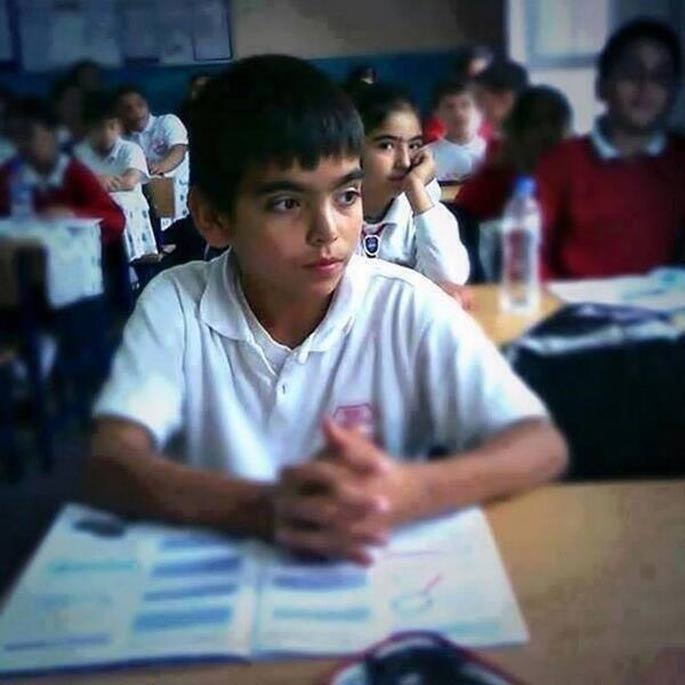
Berkin Elvan was critically injured on 16 June 2013 after being struck in the head by a tear gas canister fired by police during the Gezi Park protests in Istanbul’s Okmeydanı neighbourhood. He arrived at hospital in cardiac arrest, underwent emergency surgery, and suffered a severe brain haemorrhage. After spending 269 days in treatment at Okmeydanı Training and Research Hospital, he died on 11 March 2014.
In a criminal complaint filed on 25 June 2013, lawyers representing the Elvan family argued that firing a tear gas canister in a manner capable of causing a skull fracture and brain injury to a 14-year-old child could not be justified as a public order measure. They maintained that police officers had deliberately targeted Elvan and requested that those responsible be investigated for attempted intentional killing. They also asked prosecutors to identify the officers and commanders on duty, collect security camera footage, and hear witnesses. However, the prosecutor’s office opened the investigation under the offence of exceeding the lawful limits of the use of force. Initially, the case was handled together with other complaints against police officers arising from the Gezi Park protests, but it was later separated following objections by the family’s lawyers.
During the investigation, prosecutors requested security camera footage from the relevant police unit but were informed that the recordings were not available in the archive. Efforts to identify the officers on duty produced inconsistent results. The Istanbul Police Department first reported that 791 officers had been deployed that day, including 152 in the area where Elvan was injured. Later, prosecutors were provided with a list containing the names of 1,065 officers.
Although some footage had initially been reported missing, additional recordings emerged later in the investigation. On 20 March 2014, after a witness stated that the tear gas canister was fired from near a water cannon vehicle (TOMA), the family’s lawyers requested the vehicle’s camera recordings. On 7 April 2014, the Police Department confirmed that TOMA vehicle no. 63537, which was operating in the area, contained relevant footage. The recordings were then sent for expert examination.
In a report dated 9 November 2014, the First Specialised Board of the Forensic Medicine Institute concluded that Berkin Elvan died as a result of a head injury caused by a hard object. The report stated that the injury may have resulted from being struck by a hard object, from falling and hitting his head, or from being hit by another person with a blunt object. It further noted that medical examination alone could not determine the firing distance of a tear gas canister or plastic bullet, nor whether the shooter deliberately targeted Elvan. These issues, it said, would need to be clarified through the criminal investigation.
The investigation, during which six different prosecutors were assigned to the case, was completed on 20 December 2016. An indictment submitted to the Istanbul 17th High Criminal Court sought a life sentence for police officer Fatih Dalgalı on charges of killing with eventual intent (dolus eventualis). Prosecutors decided not to bring charges against the other 42 officers who were investigated.
During the trial, Fatih Dalgalı attended hearings by video link. He denied being the officer seen in the footage and argued that he was not the only officer using the tear gas launcher known as a ZET launcher on the day of the incident. At the hearing on 16 November 2017, the court was presented with a report prepared by TÜBİTAK based on its analysis of the available footage. Lawyers for the Elvan family objected to the report, arguing that the images had not been enhanced but had instead been degraded during the examination process.
At the hearing on 10 May 2018, the court was presented with a report prepared by the Istanbul Gendarmerie Criminal Laboratory. According to the report, there was more than a 70 per cent likelihood that the person in the footage was Fatih Dalgalı. Despite this finding, requests by the family’s lawyers to detain the defendant were rejected. The court also requested an expert opinion from the Forensic Medicine Institute, but the Institute responded that the matter fell outside its area of expertise.
At the hearing on 28 November 2018, the court continued hearing police officers who had been on duty during the protests. Witnesses were shown footage from the scene through the SEGBİS system. The officers stated that they either did not recognise the individual in the footage or could not remember the events. However, a new expert report submitted to the court on 23 January 2019 concluded that Fatih Dalgalı fired the shot that injured Berkin Elvan. Requests for his detention were nevertheless rejected once again.
Following a court order, a site inspection was carried out on 10 April 2019 with the participation of experts. Afterwards, the court ordered further expert reports to determine whether the defendant acted contrary to the rules governing the use of tear gas launchers and whether he bore responsibility for the incident.
At the hearing on 13 November 2019, the court received a report prepared by tear gas launcher instructors from the Gendarmerie Training Command in Foça, İzmir. The report stated that the defendant had received training in the use of tear gas launchers and was aware of the legal limits governing their use. However, it could not determine whether he deliberately aimed at a specific target. Because the report did not fully answer the court’s questions, the file was referred once again to the Forensic Medicine Institute.
Another expert report, prepared by the Gendarmerie on 24 January 2020, concluded that the police intervention complied with the relevant regulations. The report argued that Berkin Elvan bore partial responsibility because he was present in an area where demonstrators were gathered and therefore failed to take sufficient care for his own safety. It also stated that the tear gas canister left the launcher at a speed of 75 metres per second and described the shooting as an “unintentional and instantaneous” event. The Forensic Medicine Institute declined to assess the report, stating that doing so fell outside its mandate, and returned the file to the court.
At the hearing on 23 September 2020, the court sent the case file to the prosecutor’s office for preparation of the prosecutor’s final opinion. During this stage of the proceedings, the composition of the trial bench changed after the presiding judge, Canel Rüzgar, was appointed to the Court of Cassation.
At the hearing on 29 January 2021, lawyers representing the Elvan family requested that the new presiding judge, Mehmet Galip Perk, withdraw from the case, arguing that his previous decisions in the Gezi Trial and his social media posts raised concerns about his impartiality. During the same hearing, the prosecutor’s final opinion was read out. Unlike the indictment, which accused Fatih Dalgalı of killing with eventual intent (dolus eventualis), the prosecutor requested his conviction for causing death by conscious negligence.
At the final hearing on 18 June 2021, the Istanbul 17th High Criminal Court found that Fatih Dalgalı acted with eventual intent. The court initially imposed a life sentence for intentional killing. After finding that the offence was committed with eventual intent rather than direct intent, it reduced the sentence to 20 years’ imprisonment. Following further sentence reductions, Fatih Dalgalı was ultimately sentenced to 16 years and 8 months’ imprisonment.
The court rejected requests to apply the aggravated form of intentional killing of a child under Article 82(1)(e) of the Turkish Penal Code, finding that there was insufficient evidence to show that the defendant knew Berkin Elvan was a child when he fired the shot. Requests to detain the defendant were also rejected. Instead, the court imposed only a travel ban as a judicial control measure.
Following the trial court's judgment, an appeal was lodged with the Regional Court of Appeal. The 1st Criminal Chamber of the Istanbul Regional Court of Appeal upheld the sentence.
A further appeal was lodged with the Court of Cassation. The 1st Criminal Chamber of the Court of Cassation upheld the sentence of 16 years and 8 months' imprisonment imposed on police officer Fatih Dalgalı by the Istanbul 17th Assize Court on 18 June 2021 for killing with eventual intent.